The sirens didn’t scream. They hummed—low, steady, almost kind.
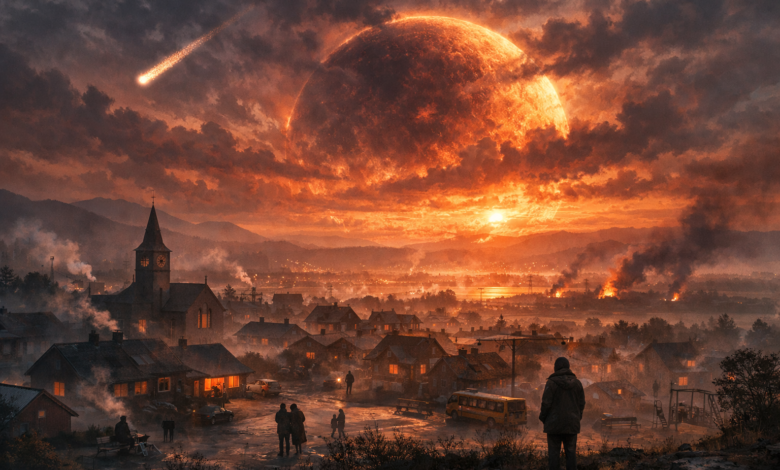
That was how the town of Briar Hollow woke on its last morning.

At exactly six a.m., every clock stopped pretending. Phones lit up with the same message, delivered without explanation or sender:
TODAY IS THE LAST DAY.
MIDNIGHT IS THE END.
No fire fell from the sky. No earthquakes split the streets. The bakery still smelled of warm bread. Birds still argued on the telephone wires. But certainty settled over the town like a second gravity. People stepped outside, looked at one another, and somehow knew—this wasn’t a warning. It was a statement.
Eli Mercer woke to the hum and to a name he hadn’t heard in fifteen years.
Lena.
It wasn’t spoken aloud. It was the way memory sometimes arrives—not knocking, but sitting at the edge of your bed, already there.
Eli lay still, staring at the cracked ceiling of his childhood home. He had moved back three months earlier, after his mother’s stroke, after the doctors said someone should be here. He had told himself it was temporary. Everything was always temporary when you were running from something.
The town had not forgotten Lena.
Her name was scratched into the old bridge railing, carved too deep by teenage hands. It lived in the creek where kids still dared each other to jump. It lingered in the empty lot where a house once stood—her house.
And it lived in Eli, sealed behind fifteen years of careful silence.
By midmorning, Briar Hollow unraveled politely.
People quit their jobs without drama. Teachers let kids draw pictures instead of taking tests. Strangers hugged like old friends. Confessions floated through the air—love admitted too late, apologies offered too early. The church bells rang once, then stopped, as if they, too, felt it would be rude to keep time now.
Eli walked without knowing where he was going until his feet carried him to the bridge.
The river below moved as it always had, indifferent and faithful. He gripped the railing where Lena had carved their initials—E + L—the heart uneven, rushed, like she’d been afraid someone would stop her.
They were seventeen the summer she died.
Everyone said it was an accident. A late night. A wet road. A sharp curve just past the mill. Everyone said these things happen and no one’s to blame.
Everyone except Eli.
Because he remembered the argument. He remembered the words he threw like stones.
If you leave, don’t bother coming back.
He remembered her face in the headlights, hurt flashing into something harder—resolve.
And he remembered doing nothing as she drove away.
The truth—buried, avoided, smothered by time—rose now, undeniable as the hum in the air.
Lena hadn’t just died.
She had been running.
From him.
From a secret she had tried to tell him that night, standing by her car with hands shaking.
I need to tell you something, she had said.
And he had cut her off.
Eli sank to his knees on the bridge as the memory finished itself at last.
She had been pregnant.
He had known—felt—and he had been afraid. Afraid of the town, of his father, of the future pressing in too fast. So he chose the one thing he was good at even then.
He chose silence.
A shadow fell across the bridge.
Eli looked up.
Lena stood there, just as she had at seventeen—wind-tangled hair, eyes too bright to belong to the living. She wasn’t solid, not exactly. The river showed through her coat. But her smile was real, soft and unbearaging.
“You finally remembered,” she said.
His throat closed. “I’m sorry,” he whispered, the words breaking open years too late. “I should’ve listened. I should’ve stopped you. I should’ve—”
“I know,” she said gently. “That’s why I’m here.”
The sky had begun to dim, the sun sliding faster now, as if time itself was eager to be done.
“You don’t get forever,” Lena said. “But you get today.”
Eli wiped his face with shaking hands. “Why now?”
“Because the end doesn’t erase who you were,” she said. “It shows you who you can still be.”
Around them, the town slowed. People sat on porches. Held hands. Watched the sky bruise into evening.
“I carried your silence for a long time,” Lena said. “But you don’t have to carry it anymore.”
“What do I do?” Eli asked. “How do I fix something when there’s no tomorrow?”
She stepped closer, her presence warm despite everything. “You don’t fix the past,” she said. “You face it. And you choose differently now.”
So Eli stood.
He went to the empty lot where her house had been. He spoke her name out loud for the first time since the funeral. He told the truth—to the air, to the town, to himself. He apologized without defending himself. He forgave himself without excusing what he had done.
When he returned to the bridge, Lena was fading, the stars bleeding through her like promises.
“Thank you,” he said.
She smiled, tears bright as the first night they’d kissed. “Take this version of you wherever you’re going,” she said. “Endings don’t get to decide that.”
At midnight, the hum stopped.
There was no explosion. No darkness. Just a sudden, profound stillness—like a breath finally released.
And in that final moment, Eli Mercer was no longer running.
He was facing forward.
And that, somehow, was enough.
Also Read: The Truth We Buried: A Story of Love and Healing